
Operators Know: EMRs Don’t Deserve to Be the Product Anymore
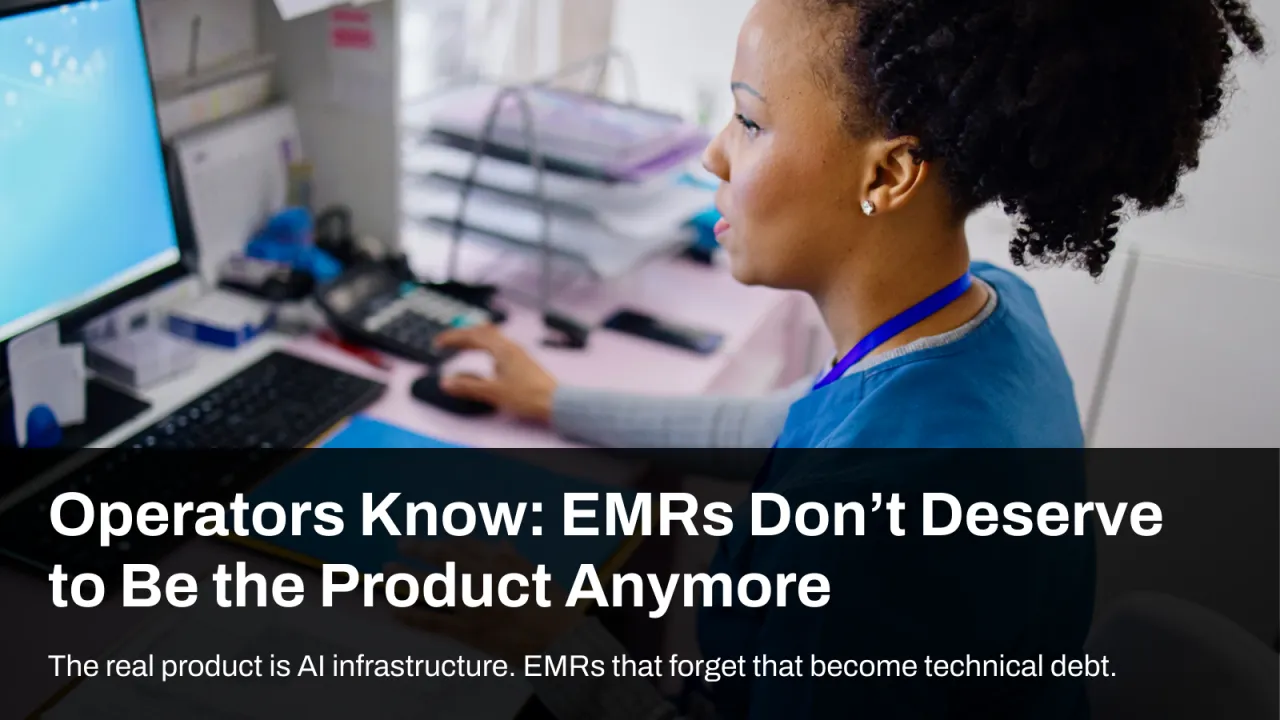
The real product is AI infrastructure. EMRs that forget that become technical debt.
Operators know when a system is working for them and when they’re just paying rent on somebody else’s technical debt. In 2026, that’s the real line between AI “platforms” that will survive and those that will disappear.
In a recent post, I argued that in healthcare tech, “anything is possible” often means “nothing will scale.” We’ve all seen the pattern: dazzling demos, endless promises of customization, and then three years of upgrades that break more than they fix. In this piece, I want to go a step further. EMRs don’t deserve to be the product anymore, and in a world of nurse burnout, cyber risk, and shrinking margins, technical debt is death.
EMRs don’t deserve to be the product anymore, and in a world of nurse burnout, cyber risk, and shrinking margins, technical debt is death.
Operators know where the pain lives. When nurses tell KLAS that their EHR is a direct contributor to burnout and intent to leave, they are not talking about abstract usability; they are describing specific clicks, specific screens, and specific delays that bleed into nights and weekends. CIOs and COOs feel the same pattern in a different language: AI on every board deck, but 2026 roadmaps dominated by cyber-resilience, compliance, and basic reliability. As I wrote in “When ‘Anything Is Possible’ Means ‘Nothing Will Scale’” systems that can’t be upgraded safely, observed clearly, and governed simply are not investable, no matter how impressive their demos are.
Technical debt is death in this environment. In other complex systems I’ve worked on, from multiscale models of batteries to coupled energy systems, the worst failures happened at the interfaces – where models, materials, controls, and incentives met – not in the components we were proudest of. Healthcare IT is behaving the same way. Every one-off customization, brittle integration, and bolt on AI feature accumulates into a stack that is harder to secure, harder to patch, and harder to evolve. When shipping a security update feels like a highwire act because “fixing one behavior might break three others,” you are not running a platform; you are running a risk engine.
Every one-off customization, brittle integration, and bolt on AI feature accumulates into a stack that is harder to secure, harder to patch, and harder to evolve.
The market is quietly signaling that it sees this. Less than two years after launch, NurseMagic® has been named a finalist for Nurse.org’s “Best of Nursing: AI Nursing Tool” award – recognition from one of the largest online nursing communities. That kind of traction does not happen because a product has the shiniest models; it happens when nurses see reductions in afterhours charting, more defensible documentation, and less friction in everyday work. At the same time, the component that used to be the most expensive line item – the EMR – is increasingly the thing that rides along with documentation, not the thing that dictates it. NurseMagic® EMR, for example, is designed to coexist with or replace legacy systems and is priced based on patient census rather than perseat licenses. Our new offering at https://www.nursemagic.ai/free-emr reflects that shift plainly: in post-acute care, the work is documentation and care; the EMR should behave like infrastructure.
...the component that used to be the most expensive line item – the EMR – is increasingly the thing that rides along with documentation, not the thing that dictates it.
This is the core architectural point: EMR, documentation, and AI must behave as one system. In a welldesigned stack, there is a single operating system for the visit: clinicians move through the work once, AI assists at the point of documentation and decision, and the EMR is simply the durable record of what happened – structured, longitudinal, and immediately usable. In a badly designed stack, EMR, workflow engine, and AI tools are loosely coupled subsystems, each with their own state, their own business model, and their own failure modes. The result is not intelligence; it is a stiff, noisy control problem masquerading as a product portfolio.
Bottom line – EMRs just don’t deserve to be the product anymore.
Bottom line – EMRs just don’t deserve to be the product anymore. That might have been sustainable when there were few alternatives and AI was a slide at the end of the deck. It is not sustainable when operators can see, in real deployments, that the value is in the combination of AI-assisted documentation and reliable recordkeeping, delivered as one service.
Offering EMR with documentation through a model like https://www.nursemagic.ai/free-emr is not about generosity; it is about aligning incentives so that the system can scale without punishing growth. If technical debt is death, then economic misalignment is shock – it knocks a system down even when the components look fine on paper.
So where does AI belong, if we want to avoid building more deadly debt? In the controllable parts of the loop: documentation, order flow, revenue cycle – the places where behavior can be observed, logged, and reversed when needed. The decision rule is simple: if you can’t explain how the AI changes state, how you would roll back a bad change, and how you will keep it secure over time, you are adding technical debt, not removing it.
The decision rule is simple: if you can’t explain how the AI changes state, how you would roll back a bad change, and how you will keep it secure over time, you are adding technical debt, not removing it.
Serious buyers and investors are already using tougher filters, whether or not they call them that. They are asking a different set of questions in 2026: How many times does my nurse touch the same data in your stack? How quickly can you ship a security patch without interrupting care? What happens to my P&L if my volume doubles? What is the state of my data and workflows if you disappear? Those are not “innovation” questions; they are survival questions.
Operators already know which systems make their days easier and which ones quietly steal time, money, and trust. The rest of us should listen.
The shakeout that’s coming will not be about who has the most AI features. It will be about who treated EMR as infrastructure, not a tollbooth; who embedded AI in the work, not just on the slides; and who treated technical debt as death before the market did it for them. Operators already know which systems make their days easier and which ones quietly steal time, money, and trust. The rest of us should listen.
Liked this blog? View the original post here on LinkedIn.